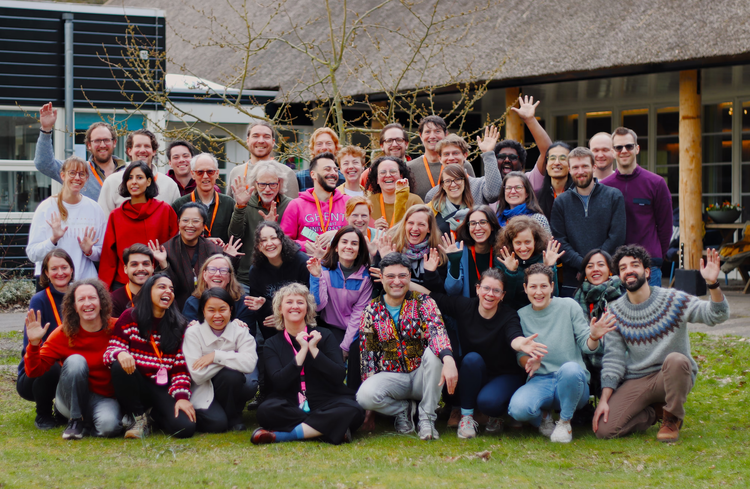
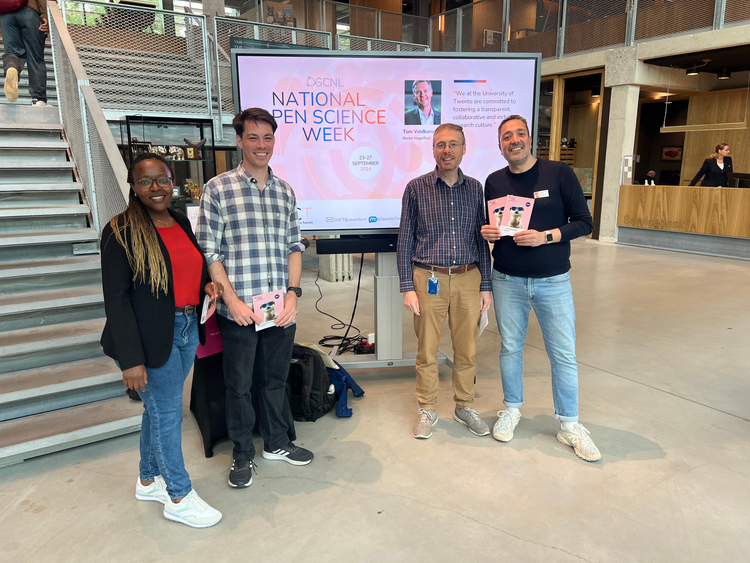
We as OSCT organize various events in collaboration with different parties, such as the UT Digital Competence Centre (DCC) and Saxion Research Services (SRS). These events last approximately 60 minutes, cover a variety of topics, and are open to all. The goals of these events are to:
These events also help people get to know each other better, including across departments.
As the OSCT is a bottom-up community, you also have power over the events' topics. So please feel free to suggest any topics you would like to discuss and share your ideas. Simply fill out the form and tell us about your idea. The same applies to the monthly newsletter to which you can also contribute.
We look forward to seeing you at one of the upcoming events.
When: 20 October 2026, 10:00 - 17:00
Where: LA 1208 (Langezijds building, UT)
Speaker: Frank Ostermann
Abstract
How confident are you that your research can be reproduced months after publication? CodeCheck provides a practical, collaborative way to test and strengthen the reproducibility of your research. On 20 October, 2026, PhD candidates, postdoctoral researchers, and professors at the University of Twente can have a reviewer reproduce a research output by following their code and documentation. Participants receive personalized feedback, identify potential issues, and gain practical tips for improving their research workflow.
Submit a reproducibility package by 13 October, 2026. Research that meets the CodeCheck reproducibility criteria can earn a voucher. Successfully reproduced projects can receive a CodeCheck certificate and badge, while participants can also earn vouchers and TGS credits. Moreover, please register here.
How to Participate
First, submit your reproducibility package. Then, join us for the Reproducibility Hackathon!
1) Submission
Deadline: 13 October, 2026
Send an email to software-stewards-lisa@utwente.nl with:
The package should enable the reproduction of a research output from a published paper, preprint, or ongoing project. See the mini submission example in the repository and use the reusable-code checklist to improve your chances of success. You can also prepare your submission at the Code Café: Hands-on Session on Reproducibility on 16 September, 2026.
2) Reproducibility Hackathon
20 October, 10:00–15:30 | LA 1208 (UT)
Team up with a reviewer who will reproduce your research by following your documentation. Discuss challenges, troubleshoot issues, and receive personalized feedback and practical tips to strengthen your workflow and reproducibility.
What can you gain?
Join CodeCheck and turn reproducibility from a challenge into a practical, collaborative experience. Questions? Contact us at software-stewards-lisa@utwente.nl.
Programme
10:00 - 10:30 | Introduction of the event and reviewers; introducing code check pairs; how to review and create a repo and demonstration |
10:30 - 11:30 | Session 1 |
11:30 - 11:45 | Coffee break |
11:45 - 12:30 | Session 2 |
12:30 - 13:30 | Lunch |
13:30 - 14:15 | Session 3 |
14:15 - 14:30 | Coffee break |
14:30 - 15:15 | Session 4 |
15:15 - 15:30 | Closure and open discussion about challenges and gains in reproducibility |
15:30 - 17:00 | Networking |
When: 29 October 2026, 14:00 - 15:00
Where: Vrijhof 354 (UT) & MS Teams (Join online)
Speaker: Annika van der Putten & Willem Jan Bos
Abstract
Do you collect personal data in your research but feel unsure where the lines are? In this hybrid event, Willem Jan Bos (UT Data Protection Officer, DPO) and Annika van der Putten (UT Privacy Officer) will walk you through the practical basics: what counts as personal data, what makes a category "special" under Article 9 of the GDPR, and which data can be sensitive even when the GDPR does not label it that way. Moreover, you will learn when a Data Protection Impact Assessment (DPIA) is required and what it involves, how and when to use the pre-DPIA form (a step researchers often skip or confuse with the GDPR tool), and the questions worth asking yourself before you start collecting: do I really need this data, can I protect it better, and who should I contact for advice? We will also explain how privacy support is organised at the UT, including the roles of privacy contact persons, Privacy Officers and the DPO.
When: 25 February 2027, 14:00 - 15:00
Where: LA 1261 (Langezijds building, UT) and MS Teams (join)
Speaker: Efe Sözeri
Abstract
In this hybrid event, Efe (UT Software Steward) will walk you through the basics of GitHub: opening an account, creating your first repository, adding a README file, picking a license, and version-controlling your changes. We'll then pick a publicly available open-source project on GitHub to fork and modify together.
Feel free to bring your laptop, or even just your phone, and follow along with the screen-shared steps to practice GitHub with us.
When: 25 March 2027, 14:00 - 15:00
Where: LA 1261 (Langezijds building, UT) and MS Teams (join)
Speaker: Efe Sözeri
Abstract
In this hybrid event, you will be introduced to the six open-source software licenses pre-approved at UT: MIT, BSD, Apache, GPL, EUPL, and Mozilla.
We will explain the main differences between permissive and copyleft licenses, why you need one, how to choose one, and what that entails for the future of your research software.
If your research project includes any code, don't miss this session.
Contributions from the community are key to the success of our OSCT. We consequently strongly encourage our members to initiate and organize their own events related to Open Science, e.g., workshops and hackathons. Member initiatives will be announced on this website and promoted through social media. If you have an idea in mind, please send us a message.